
Finding winged insects inside your home can be a stressful discovery. Is it a nuisance, or is your foundation under attack? While they look strikingly similar at a glance, the differences between termite swarmers and flying ants are significant. Knowing the exact species in your living space determines whether you need a simple vacuum or an intensive chemical barrier.
This guide will help you identify which pest you’re dealing with and what steps to take next. Early detection is your best defence against costly repairs. Professional pest management relies on these distinct physical and behavioural markers to provide the right solution. By the end of this article, you will feel confident in your ability to distinguish these reproductive winged pests.
Similarities of Flying Ants and Termite Swarmers
- Shared Purpose of Flight
The primary reason these insects grow wings is to mate. Both alate termites and flying ants are the “reproductives” of their colonies. They emerge in clouds to find partners, which means seeing either one indicates a mature, healthy nest is located somewhere nearby.
- Dark Pigmentation and Size
At a distance, both pests look like small, dark, flying specks. They are typically between 6 to 12 millimetres in length. This similar sizing makes it nearly impossible to tell them apart without catching a specimen and looking at it under a magnifying glass or bright light.
- Timing of Emergence
Weather triggers the arrival of both species. High humidity and a sudden rise in temperature after a rainfall often cause both to emerge at once. This overlap in timing creates significant confusion for property owners trying to identify winged insects during the spring season.
- Attraction to Light Sources
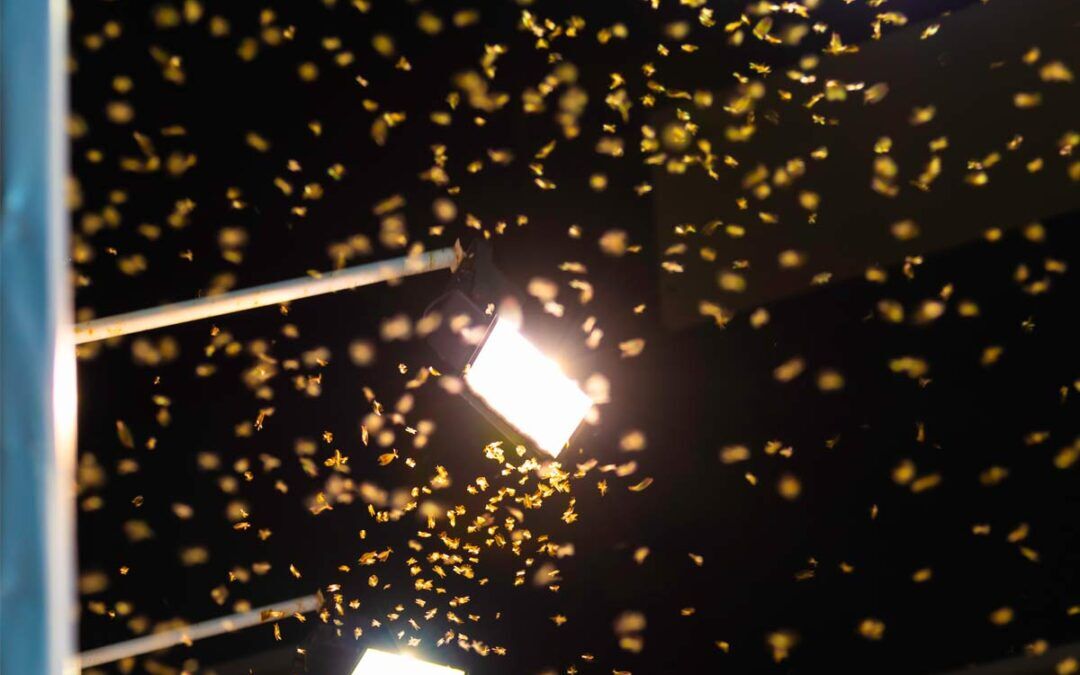
If you see bugs fluttering around your windows or lamps at night, it could be either species. Both are naturally drawn to light. Finding a pile of discarded wings on a windowsill is a common sign that a swarm of wood-destroying insects has occurred.
5 Easy Ways to Spot the Difference

- Body Shape and Waist
Look at the middle of the insect. A flying ant has a pinched, narrow “wasp-waist” with three distinct body segments. In contrast, a termite has a wide, straight body with no visible waist. This is the fastest way to distinguish termite swarmers from ants.
- Antennae Structure
Check the “feelers” on the head. Flying ants have elbowed antennae that bend at a sharp angle. Termites have straight antennae that look like tiny strings of beads. This insect anatomy identification is a dead giveaway for experts when they examine a sample under a microscope.
- Wing Length and Symmetry
Termites have four wings that are all the exact same size and shape. These wings are much longer than their bodies. Flying ants also have four wings, but the front pair is significantly larger than the back pair. This wing pattern analysis is vital.
- Wing Durability and Shedding
Termite wings are very fragile and fall off almost immediately after they land. You will often find piles of translucent wings without any insects nearby. Ant wings are more durable and stay attached much longer, making swarmer wing identification a key diagnostic tool for homeowners.
- Overall Texture and Colour
Ants often have a harder, more defined exoskeleton that may appear shiny or slightly reddish. Termites usually have a softer-looking, matte black or dark brown body. While colour varies by species, the termite body structure is generally more uniform and less segmented than an ant’s.
Behaviour and Habitat: Where Do They Hide?
- Termite Soil Dependence
Subterranean termites, the most common type in Canada, live in the soil. They build “mud tubes” to travel from the ground to the wood in your home. These tubes protect them from drying out. Seeing these tubes is a clear sign of termite colony activity.
- Ant Nesting Locations
Flying ants, particularly carpenter ants, like to nest in damp or decaying wood, but they do not eat it. They hollow out galleries to live in. You might find them in wall voids, under insulation, or near leaky pipes where the wood is soft and moisture-damaged.
- Dietary Differences
Termites eat the cellulose found in wood, paper, and cardboard. They are true wood-consuming pests. Ants are scavengers; they leave the nest to find sugar, protein, or grease. If you see “winged ants“ heading toward a spilled soda, they are likely just ants.
- Signs of Debris
Carpenter ants leave behind “frass,” which looks like coarse sawdust mixed with insect parts. Termites do not leave sawdust. Instead, some species leave behind tiny, wood-coloured pellets. Searching for pest exit holes can reveal which type of debris is present around your baseboards.
- Light Sensitivity
Termite workers are blind and hate the light, staying hidden deep inside wood or soil. You only see the swarmers because they are meant to leave. Ants are much more active in the open, and you will often see non-winged workers foraging during the day.
- Structural Damage Patterns
Termites eat wood along the grain, often leaving behind thin layers of wood or just the paint. Carpenter ants excavate smooth, clean tunnels that look like they have been sanded. This wood damage inspection helps professionals determine the severity of a residential pest infestation.
- Colony Size and Growth
A termite colony can have millions of members and takes years to reach the swarming stage. If you see swarmers, the colony is already well-established. Ant colonies are smaller but can still cause significant damage to wooden beams over several years of uncontrolled nesting.
Why You’re Seeing Them Indoors
- Emergence from Interior Walls
If you see insects crawling out of a crack in the drywall or from behind a baseboard, you likely have an active colony inside the structure. This is a common sign of indoor termite swarming, suggesting the nest is beneath or within your foundation.
- Entry Through Open Vents
Sometimes, swarmers from a nearby tree or stump get sucked into the attic through soffit vents or chimneys. In this case, you might just have a few stray winged reproductive insects that don’t necessarily indicate a full-scale infestation of the house itself.
- Attraction to High Humidity
Basements with poor ventilation or crawl spaces with standing water are magnets for both species. High humidity softens wood and creates the perfect pest breeding ground. Reducing moisture is a primary recommendation from the National Pest Management Association for homeowners.
- Proximity to Exterior Wood
Firewood stacked against the house or old mulch touching the siding provides a bridge for insects. They follow these bridges into your walls. Keeping wood debris away from the foundation is a key pest exclusion technique used to protect Canadian homes.
- Post-Rainfall Activity
Heavy rains soak the ground and force air out of subterranean tunnels, prompting termites to move upward. If your home has cracks in the slab, the insects will follow the path of least resistance, leading to an accidental indoor swarm after a storm.
- Light Lure Effect
If a swarm happens outside near your porch light, a few dozen might slip through a gap in a window screen or under a door. If you only find a few insects near an entry point, it may be a temporary pest nuisance rather than an internal infestation.
- Mature Colony Pressure
Swarming only happens when a colony is too big for its current space. Seeing them indoors means the local population is high. According to data from Environment and Climate Change Canada, warming trends in certain regions are extending the active seasons for these invasive wood pests.
When to Call a Professional
- Structural Damage Evidence
If your floors feel “spongy” or your windows are sticking for no reason, you should seek a professional pest inspection immediately. These are signs that the internal support of the wood has been compromised by long-term termite feeding.
- Recurring Annual Swarms
If you see winged insects in the same spot every spring, the colony is thriving. Persistent activity means your previous efforts didn’t work. A licensed technician can use termite baiting systems or soil treatments to kill the colony at its source.
- Uncertainty in Identification
If you can’t tell the difference between the two, don’t guess. Treating for ants when you have termites is a waste of money and gives the termites more time to eat your home. An expert pest identification service provides the clarity you need.
- Large Volumes of Wings
Finding hundreds of discarded wings is a major red flag. This indicates a massive swarm occurred inside your walls. Professionals have the tools, such as thermal imaging, to see where the insects are hiding without tearing down your drywall for pest detection.
- Peace of Mind and Warranty
Professional companies offer warranties that DIY sprays cannot. If the bugs come back, the company returns to finish the job. This is especially important for mortgage requirements and home sales, where proof of a pest-free environment is often legally required.
Distinguishing between termite swarmers and flying ants is the difference between a minor home repair and a major structural crisis. While ants are certainly a nuisance, termites represent a silent threat that can go unnoticed for years until the damage is severe. By looking at the waist, wings, and antennae, you can take control of the situation and decide on the best course of action for your property. Never ignore the signs of a swarm, as these insects are the primary messengers of a much larger hidden population.

If you have spotted wings on your windowsill or seen dark insects emerging from your walls, do not wait for the damage to spread. Timely intervention saves thousands of dollars in restoration costs. For expert identification and reliable removal, reach out to the specialists at Mr. Pest Control. Contact us at our various locations: (705) 739-7378 (PEST) [Barrie], (705) 326-3377 [Orillia], (705) 739-7378 [Simcoe County], (705) 739-7378 [Midland & Area]
